
da pro network:
The Big Bang
posted on: 01-09-2011 source: Wikipedia
comments: disabled
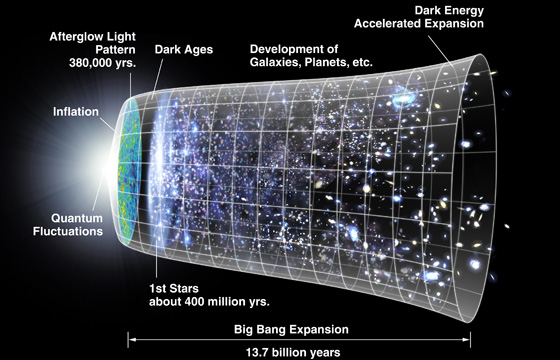 Big Bang Expansion
The Big Bang is a well-tested scientific theory which is widely accepted within the scientific community because it is the most accurate and comprehensive explanation for the full range of phenomena astronomers observe. Since its conception, abundant evidence has arisen to further validate the model. Georges Lemaitre first proposed what would become the Big Bang theory in what he called his "hypothesis of the primeval atom." Over time, scientists would build on his initial ideas to form the modern synthesis. The framework for the Big Bang model relies on Albert Einstein's general relativity and on simplifying assumptions (such as homogeneity and isotropy of space). The governing equations had been formulated by Alexander Friedmann. In 1929 Edwin Hubble discovered that the distances to far away galaxies were generally proportional to their redshifts an idea originally suggested by Lemaitre in 1927. Hubble's observation was taken to indicate that all very distant galaxies and clusters have an apparent velocity directly away from our vantage point: the farther away, the higher the apparent velocity.
If the distance between galaxy clusters is increasing today, everything must have been closer together in the past. This idea has been considered in detail back in time to extreme densities and temperatures, and large particle accelerators have been built to experiment on and test such conditions, resulting in significant confirmation of this model. On the other hand, these accelerators have limited capabilities to probe into such high energy regimes. There is little evidence regarding the absolute earliest instant of the expansion. Thus, the Big Bang theory cannot and does not provide any explanation for such an initial condition; rather, it describes and explains the general evolution of the universe going forward from that point on. The observed abundances of the light elements throughout the cosmos closely match the calculated predictions for the formation of these elements from nuclear processes in the rapidly expanding and cooling first minutes of the universe, as logically and quantitatively detailed according to Big Bang nucleosynthesis.
Fred Hoyle is credited with coining the term Big Bang during a 1949 radio broadcast. It is popularly reported that Hoyle, who favored an alternative "steady state" cosmological model, intended this to be pejorative, but Hoyle explicitly denied this and said it was just a striking image meant to highlight the difference between the two models. After the discovery of the cosmic microwave background radiation in 1964, and especially when its spectrum (i.e., the amount of radiation measured at each wavelength) was found to match that of thermal radiation from a black body, most scientists were fairly convinced by the evidence that some version of the Big Bang scenario must have occurred.
Timeline of the Big Bang
Extrapolation of the expansion of the Universe backwards in time using general relativity yields an infinite density and temperature at a finite time in the past. This singularity signals the breakdown of general relativity. How closely we can extrapolate towards the singularity is debated certainly no closer than the end of the Planck epoch. This singularity is sometimes called "the Big Bang", but the term can also refer to the early hot, dense phase itself, which can be considered the "birth" of our Universe. Based on measurements of the expansion using Type Ia supernovae, measurements of temperature fluctuations in the cosmic microwave background, and measurements of the correlation function of galaxies, the Universe has a calculated age of 13.75 +/- 0.11 billion years. The agreement of these three independent measurements strongly supports the Lambda-CDM model that describes in detail the contents of the Universe.
The earliest phases of the Big Bang are subject to much speculation. In the most common models the Universe was filled homogeneously and isotropically with an incredibly high energy density and huge temperatures and pressures and was very rapidly expanding and cooling. Approximately 10-37 seconds into the expansion, a phase transition caused a cosmic inflation, during which the Universe grew exponentially. After inflation stopped, the Universe consisted of a quark-gluon plasma, as well as all other elementary particles. Temperatures were so high that the random motions of particles were at relativistic speeds, and particle-antiparticle pairs of all kinds were being continuously created and destroyed in collisions. At some point an unknown reaction called baryogenesis violated the conservation of baryon number, leading to a very small excess of quarks and leptons over antiquarks and antileptons of the order of one part in 30 million. This resulted in the predominance of matter over antimatter in the present Universe.
The Universe continued to grow in size and fall in temperature, hence the typical energy of each particle was decreasing. Symmetry breaking phase transitions put the fundamental forces of physics and the parameters of elementary particles into their present form. After about 10-11 seconds, the picture becomes less speculative, since particle energies drop to values that can be attained in particle physics experiments. At about 10-6 seconds, quarks and gluons combined to form baryons such as protons and neutrons. The small excess of quarks over antiquarks led to a small excess of baryons over antibaryons. The temperature was now no longer high enough to create new proton-antiproton pairs (similarly for neutrons-antineutrons), so a mass annihilation immediately followed, leaving just one in 1010 of the original protons and neutrons, and none of their antiparticles. A similar process happened at about 1 second for electrons and positrons. After these annihilations, the remaining protons, neutrons and electrons were no longer moving relativistically and the energy density of the Universe was dominated by photons (with a minor contribution from neutrinos).
A few minutes into the expansion, when the temperature was about a billion (one thousand million; 109; SI prefix giga-) kelvin and the density was about that of air, neutrons combined with protons to form the Universe's deuterium and helium nuclei in a process called Big Bang nucleosynthesis. Most protons remained uncombined as hydrogen nuclei. As the Universe cooled, the rest mass energy density of matter came to gravitationally dominate that of the photon radiation. After about 379,000 years the electrons and nuclei combined into atoms (mostly hydrogen); hence the radiation decoupled from matter and continued through space largely unimpeded. This relic radiation is known as the cosmic microwave background radiation.
Over a long period of time, the slightly denser regions of the nearly uniformly distributed matter gravitationally attracted nearby matter and thus grew even denser, forming gas clouds, stars, galaxies, and the other astronomical structures observable today. The details of this process depend on the amount and type of matter in the Universe. The four possible types of matter are known as cold dark matter, warm dark matter, hot dark matter and baryonic matter. The best measurements available (from WMAP) show that the data is well-fit by a Lambda-CDM model in which dark matter is assumed to be cold (warm dark matter is ruled out by early reionization), and is estimated to make up about 23% of the matter/energy of the universe, while baryonic matter makes up about 4.6%. In an "extended model" which includes hot dark matter in the form of neutrinos, then if the "physical baryon density" is estimated at about 0.023 (this is different from the 'baryon density' expressed as a fraction of the total matter/energy density, which as noted above is about 0.046), and the corresponding cold dark matter density is about 0.11, the corresponding neutrino density is estimated to be less than 0.0062.
Independent lines of evidence from Type Ia supernovae and the CMB imply that the Universe today is dominated by a mysterious form of energy known as dark energy, which apparently permeates all of space. The observations suggest 73% of the total energy density of today's Universe is in this form. When the Universe was very young, it was likely infused with dark energy, but with less space and everything closer together, gravity had the upper hand, and it was slowly braking the expansion. But eventually, after numerous billion years of expansion, the growing abundance of dark energy caused the expansion of the Universe to slowly begin to accelerate. Dark energy in its simplest formulation takes the form of the cosmological constant term in Einstein's field equations of general relativity, but its composition and mechanism are unknown and, more generally, the details of its equation of state and relationship with the Standard Model of particle physics continue to be investigated both observationally and theoretically.
All of this cosmic evolution after the inflationary epoch can be rigorously described and modeled by the Lambda-CDM model of cosmology, which uses the independent frameworks of quantum mechanics and Einstein's General Relativity. As noted above, there is no well-supported model describing the action prior to 10-15 seconds or so. Apparently a new unified theory of quantum gravitation is needed to break this barrier. Understanding this earliest of eras in the history of the Universe is currently one of the greatest unsolved problems in physics.
Cosmic microwave background radiation
During the first few days of the Universe, the Universe was in full thermal equilibrium, with photons being continually emitted and absorbed, giving the radiation a blackbody spectrum. As the Universe expanded, it cooled to a temperature at which photons could no longer be created or destroyed. The temperature was still high enough for electrons and nuclei to remain unbound, however, and photons were constantly "reflected" from these free electrons through a process called Thomson scattering. Because of this repeated scattering, the early Universe was opaque to light.
When the temperature fell to a few thousand Kelvin, electrons and nuclei began to combine to form atoms, a process known as recombination. Since photons scatter infrequently from neutral atoms, radiation decoupled from matter when nearly all the electrons had recombined, at the epoch of last scattering, 379,000 years after the Big Bang. These photons make up the CMB that is observed today, and the observed pattern of fluctuations in the CMB is a direct picture of the Universe at this early epoch. The energy of photons was subsequently redshifted by the expansion of the Universe, which preserved the blackbody spectrum but caused its temperature to fall, meaning that the photons now fall into the microwave region of the electromagnetic spectrum. The radiation is thought to be observable at every point in the Universe, and comes from all directions with (almost) the same intensity.
In 1964 Arno Penzias and Robert Wilson accidentally discovered the cosmic background radiation while conducting diagnostic observations using a new microwave receiver owned by Bell Laboratories. Their discovery provided substantial confirmation of the general CMB predictions-the radiation was found to be isotropic and consistent with a blackbody spectrum of about 3 K - and it pitched the balance of opinion in favor of the Big Bang hypothesis. Penzias and Wilson were awarded a Nobel Prize for their discovery.
The cosmic microwave background spectrum measured by the FIRAS instrument on the COBE satellite is the most-precisely measured black body spectrum in nature.
In 1989 NASA launched the Cosmic Background Explorer satellite (COBE), and the initial findings, released in 1990, were consistent with the Big Bang's predictions regarding the CMB. COBE found a residual temperature of 2.726 K and in 1992 detected for the first time the fluctuations (anisotropies) in the CMB, at a level of about one part in 105. John C. Mather and George Smoot were awarded the Nobel Prize for their leadership in this work. During the following decade, CMB anisotropies were further investigated by a large number of ground-based and balloon experiments. In 2000-2001 several experiments, most notably BOOMERanG, found the Universe to be almost spatially flat by measuring the typical angular size (the size on the sky) of the anisotropies.
In early 2003 the first results of the Wilkinson Microwave Anisotropy Probe (WMAP) were released, yielding what were at the time the most accurate values for some of the cosmological parameters. This spacecraft also disproved several specific cosmic inflation models, but the results were consistent with the inflation theory in general, it confirms too that a sea of cosmic neutrinos permeates the Universe, a clear evidence that the first stars took more than a half-billion years to create a cosmic fog. A new space probe named Planck, with goals similar to WMAP, was launched in May 2009. It is anticipated to soon provide even more accurate measurements of the CMB anisotropies. Many other ground and balloon based experiments are also currently running.
The background radiation is exceptionally smooth, which presented a problem in that conventional expansion would mean that photons coming from opposite directions in the sky were coming from regions that had never been in contact with each other. The leading explanation for this far reaching equilibrium is that the Universe had a brief period of rapid exponential expansion, called inflation. This would have the effect of driving apart regions that had been in equilibrium, so that all the observable Universe was from the same equilibrated region.
feature picture
NGC 7380: The Wizard Nebula

celestial events
October 2026
space programs
Curiosity
James Webb Space Telescope
Kepler Telescope
Hubble Space Telescope
International Space Station
Space Shuttle
Apollo 11
learn more at:
wiki
Voyager 1-2
Cold War - Space Race
learn more at:
wiki
feature video