ESA's Cluster satellites in closest-ever 'Dance in Space'
posted on: 24-09-2013 source: ESA comments: 0
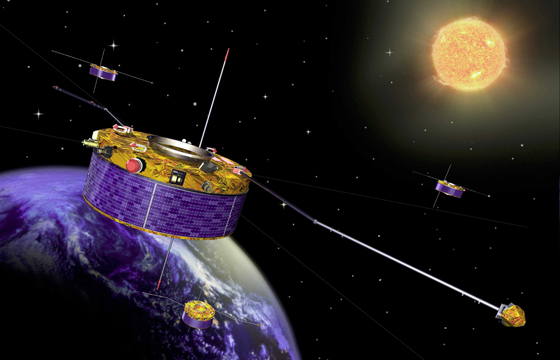
The Cluster Constellation
Since 2000, the four identical satellites of the Cluster quartet have been probing Earth's magnetosphere in three dimensions. This week, two of them made their closest-ever approach, just 4km, enabling valuable data to be acquired with unprecedented detail.
In an orbital reconfiguration that will help to maintain the mission's life span, two of the four satellites achieved their closest-ever separation on 19 September, closing to wit... whole story

Hubble captures comet ISON
posted on: 26-04-2013 source: NASA comments: 0
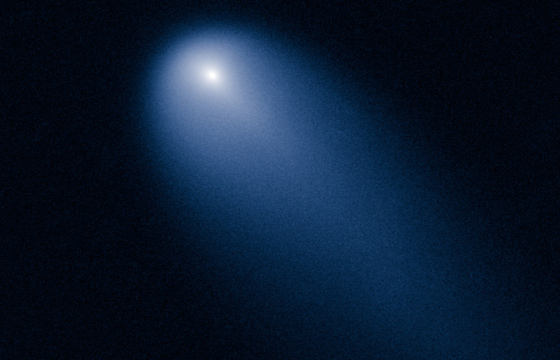
Comet 'ISON'
This NASA Hubble Space Telescope image of Comet (C/2012 S1) ISON was photographed on April 10, when the comet was slightly closer than Jupiter's orbit at a distance of 386 million miles from the Sun (394 million miles from Earth).
Even at that great distance the comet is already active as sunlight warms the surface and causes frozen volatiles to sublimate. A detailed analysis of the dust coma surrounding the solid, icy nucleus reveal... whole story

Hunting massive Stars with Herschel
posted on: 29-03-2013 source: NASA comments: 0
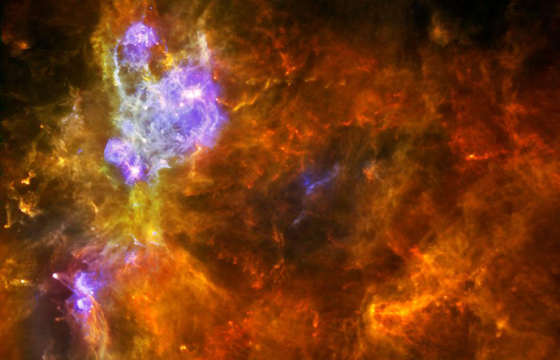
W3 gas cloud
In this new view of a vast star-forming cloud called W3, the Herschel space observatory tells the story of how massive stars are born. Herschel is a European Space Agency mission with important NASA contributions. W3 is a giant gas cloud containing an enormous stellar nursery, some 6,200 light-years away in the Perseus Arm, one of our Milky Way galaxy's main spiral arms.
By studying regions of massive star formation in W3, scientists... whole story

NASA Voyager status update on Voyager 1 location
posted on: 20-03-2013 source: NASA comments: 0
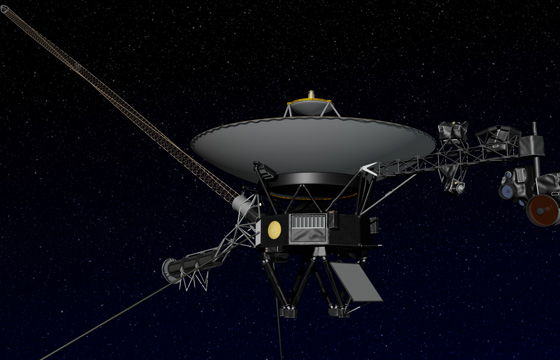
Voyager Spacecraft
"The Voyager team is aware of reports today that NASA's Voyager 1 has left the solar system," said Edward Stone, Voyager project scientist based at the California Institute of Technology, Pasadena, Calif. "It is the consensus of the Voyager science team that Voyager 1 has not yet left the solar system or reached interstellar space. In December 2012, the Voyager science team reported that Voyager 1 is within a new region called 'the magn... whole story

NASA's SDO observes fast-growing sunspot
posted on: 25-02-2013 source: NASA comments: 0
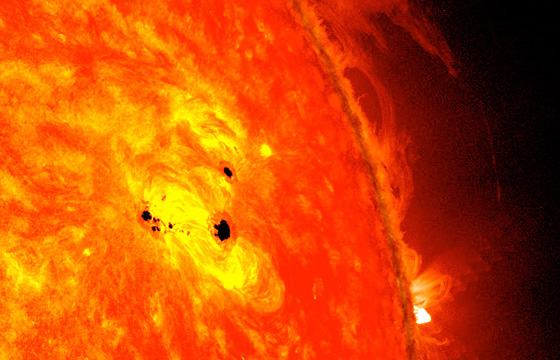
The Sun 'Sunspots'
As magnetic fields on the sun rearrange and realign, dark spots known as sunspots can appear on its surface. Over the course of February 19-20, 2013, scientists watched a giant sunspot form in under 48 hours. It has grown to over six Earth diameters across but its full extent is hard to judge since the spot lies on a sphere not a flat disk.
The spot quickly evolved into what's called a delta region, in which the lighter areas around ... whole story
feature picture

NGC 5965 and NGC 5963

celestial events
October 2026
space programs
Curiosity
learn more at: wiki NASA
James Webb Space Telescope
learn more at: wiki NASA
Kepler Telescope
learn more at: official wiki NASA
Hubble Space Telescope
learn more at: official wiki NASA
International Space Station
learn more at: wiki NASA ESA
Space Shuttle
learn more at: wiki NASA
Apollo 11
learn more at: wiki
Voyager 1-2
learn more at: wiki NASA
Cold War - Space Race
learn more at: wiki
feature video
Da Pro ©2011-2013