
da pro network:
ESA's Cluster satellites in closest-ever 'Dance in Space'
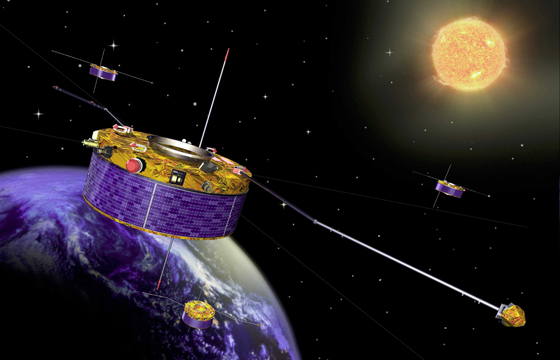 The Cluster Constellation
In an orbital reconfiguration that will help to maintain the mission's life span, two of the four satellites achieved their closest-ever separation on 19 September, closing to within just 4km of each other as they orbited at up to 23,000km/h high above Earth.
"We're optimising the Cluster formation so that the separation between Cluster 1 and the duo of Cluster 3 and 4 – which are on almost identical orbits – is kept below 100km when the formation crosses Earth's magnetic equator," says Detlef Sieg, working on Cluster flight dynamics at ESA's ESOC operations centre in Darmstadt, Germany.
The formation will hold three of the four satellites close together at lower altitudes, optimising the range of science observations.
"Following the closest-ever approach on 30 August, we achieved a new mission record with C1 and C3 yesterday, at just 4km around 09:12 GMT," says Juergen Volpp, Spacecraft Operations Manager at ESOC.
The main challenge in achieving the formation was to exclude any collision risk and to avoid further manoeuvres, which would interrupt science activities.
"We can determine the satellites orbits with an accuracy better than 0.1km," says Detlef Sieg, "so we knew we could achieve the formation with sufficient allowance for safety."
The new formation will be held until early November before the separations are increased to more than 1000km.
"When we started Cluster, we believed that a separation of 500km was the smallest required by science," says ESA's Phillipe Escoubet, Cluster Mission Scientist.
"However, it turns out that the physical processes at very small scales are very important and this is why we have decided to decrease the separation distance to more than a factor 100 to just 4km, as it will allow us to study electromagnetic waves in the radiation belts with unprecedented detail."
comments:
login to comment or register