

da pro network:
Quantum Theory
posted on: 12-09-2011 source: Wikipedia
comments: disabled
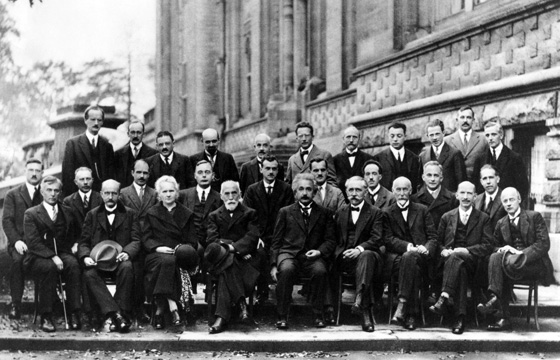 Solvay Conference (1911)
The mathematical formulations of quantum mechanics are abstract. A mathematical function called the wavefunction provides information about the probability amplitude of position, momentum, and other physical properties of a particle. Mathematical manipulations of the wavefunction usually involve the bra-ket notation, which requires an understanding of complex numbers and linear functionals. The wavefunction treats the object as a quantum harmonic oscillator and the mathematics is akin to that of acoustic resonance. Many of the results of quantum mechanics are not easily visualized in terms of classical mechanics; for instance, the ground state in the quantum mechanical model is a non-zero energy state that is the lowest permitted energy state of a system, rather than a more traditional system that is thought of as simply being at rest with zero kinetic energy.
The earliest versions of quantum mechanics were formulated in the first decade of the 20th century. At around the same time, the atomic theory and the corpuscular theory of light (as updated by Einstein) first came to be widely accepted as scientific fact; these latter theories can be viewed as quantum theories of matter and electromagnetic radiation. The early quantum theory was significantly reformulated in the mid-1920s by Werner Heisenberg, Max Born, Wolfgang Pauli and their associates, and the Copenhagen interpretation of Niels Bohr became widely accepted. By 1930, quantum mechanics had been further unified and formalized by the work of Paul Dirac and John von Neumann, with a greater emphasis placed on measurement in quantum mechanics, the statistical nature of our knowledge of reality and philosophical speculation about the role of the observer. Quantum mechanics has since branched out into almost every aspect of 20th century physics and other disciplines such as quantum chemistry, quantum electronics, quantum optics and quantum information science. Much 19th century physics has been re-evaluated as the classical limit of quantum mechanics, and its more advanced developments in terms of quantum field theory, string theory, and speculative quantum gravity theories.
The history of quantum mechanics dates back to the 1838 discovery of cathode rays by Michael Faraday. This was followed by the 1859 statement of the black body radiation problem by Gustav Kirchhoff, the 1877 suggestion by Ludwig Boltzmann that the energy states of a physical system can be discrete, and the 1900 quantum hypothesis of Max Planck. Planck's hypothesis that energy is radiated and absorbed in discrete "quanta", or "energy elements", precisely matched the observed patterns of black body radiation. According to Planck, each energy element E is proportional to its frequency v:
E = hv where h is Planck's constant. Planck cautiously insisted that this was simply an aspect of the processes of absorption and emission of radiation and had nothing to do with the physical reality of the radiation itself. However, in 1905 Albert Einstein interpreted Planck's quantum hypothesis realistically and used it to explain the photoelectric effect, in which shining light on certain materials can eject electrons from the material.
The foundations of quantum mechanics were established during the first half of the twentieth century by Niels Bohr, Werner Heisenberg, Max Planck, Louis de Broglie, Albert Einstein, Erwin Schrodinger, Max Born, John von Neumann, Paul Dirac, Wolfgang Pauli, David Hilbert, and others. In the mid-1920s, developments in quantum mechanics led to its becoming the standard formulation for atomic physics. In the summer of 1925, Bohr and Heisenberg published results that closed the "Old Quantum Theory". Out of deference to their dual state as particles, light quanta came to be called photons (1926). From Einstein's simple postulation was born a flurry of debating, theorizing and testing. Thus the entire field of quantum physics emerged, leading to its wider acceptance at the Fifth Solvay Conference in 1927.
The other exemplar that led to quantum mechanics was the study of electromagnetic waves such as light. When it was found in 1900 by Max Planck that the energy of waves could be described as consisting of small packets or quanta, Albert Einstein further developed this idea to show that an electromagnetic wave such as light could be described as a particle - later called the photon - with a discrete quanta of energy that was dependent on its frequency. This led to a theory of unity between subatomic particles and electromagnetic waves called wave-particle duality in which particles and waves were neither one nor the other, but had certain properties of both.
While quantum mechanics traditionally described the world of the very small, it is also needed to explain certain recently investigated macroscopic systems such as superconductors and superfluids.
The word quantum derives from Latin, meaning "how great" or "how much". In quantum mechanics, it refers to a discrete unit that quantum theory assigns to certain physical quantities, such as the energy of an atom at rest. The discovery that particles are discrete packets of energy with wave-like properties led to the branch of physics dealing with atomic and sub-atomic systems which is today called quantum mechanics. It is the underlying mathematical framework of many fields of physics and chemistry, including condensed matter physics, solid-state physics, atomic physics, molecular physics, computational physics, computational chemistry, quantum chemistry, particle physics, nuclear chemistry, and nuclear physics. Some fundamental aspects of the theory are still actively studied.
Quantum mechanics is essential to understand the behavior of systems at atomic length scales and smaller. For example, if classical mechanics governed the workings of an atom, electrons would rapidly travel towards and collide with the nucleus, making stable atoms impossible. However, in the natural world the electrons normally remain in an uncertain, non-deterministic "smeared" orbital path around or through the nucleus, defying classical electromagnetism.
Quantum mechanics was initially developed to provide a better explanation of the atom, especially the differences in the spectra of light emitted by different isotopes of the same element. The quantum theory of the atom was developed as an explanation for the electron remaining in its orbit, which could not be explained by Newton's laws of motion and Maxwell's laws of classical electromagnetism.
Broadly speaking, quantum mechanics incorporates four classes of phenomena for which classical physics cannot account:
The quantization of certain physical properties
Wave-particle duality
The uncertainty principle
Quantum entanglement.