
da pro network:
String Theory
posted on: 20-09-2011 source: Wikipedia
comments: disabled
 String Theory
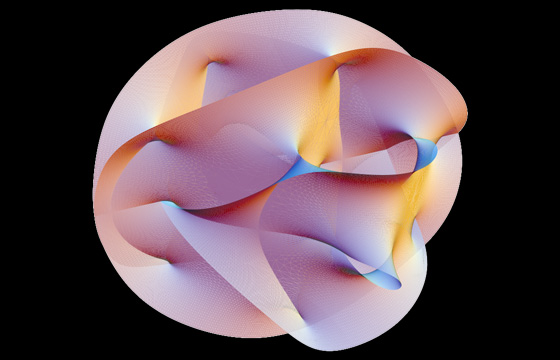
Since the string theory is widely believed to be a consistent theory of quantum gravity, many hope that it correctly describes our universe, making it a theory of everything. There are known configurations which describe all the observed fundamental forces and matter but with a zero cosmological constant and some new fields. There are other configurations with different values of the cosmological constant, which are metastable but long-lived. This leads many to believe that there is at least one metastable solution which is quantitatively identical with the standard model, with a small cosmological constant, which contains dark matter and a plausible mechanism for cosmic inflation. It is not yet known whether string theory has such a solution, nor how much freedom the theory allows to choose the details.
The full theory does not yet have a satisfactory definition in all circumstances, since the scattering of strings is most straightforwardly defined by a perturbation theory. The complete quantum mechanics of high dimensional branes is not easily defined, and the behavior of string theory in cosmological settings (time-dependent backgrounds) is not fully worked out. It is also not clear if there is any principle by which string theory selects its vacuum state, the spacetime configuration which determines the properties of our universe.
As is the case for any other quantum theory of gravity, it is widely believed that testing the theory directly would require prohibitively expensive feats of engineering. Although direct experimental testing of string theory involves grand explorations and development in engineering, there are several indirect experiments that may support string theory.
String theory can be formulated in terms of an action principle, either the Nambu-Goto action or the Polyakov action, which describes how strings move through space and time. In the absence of external interactions, string dynamics are governed by tension and kinetic energy, which combine to produce oscillations. The quantum mechanics of strings implies these oscillations take on discrete vibrational modes, the spectrum of the theory.
On distance scales larger than the string radius, each oscillation mode behaves as a different species of particle, with its mass, spin and charge determined by the string's dynamics. Splitting and recombination of strings correspond to particle emission and absorption, giving rise to the interactions between particles.
An analogy for strings modes of vibration is a guitar strings production of multiple but distinct musical notes. In the analogy, different notes correspond to different particles. The only difference is the guitar is only 2-dimensional; you can strum it up, and down. In actuality the guitar strings would be every dimension, and the strings could vibrate in any direction, meaning that the particles could move through not only our dimension, but other dimensions as well.
String theory includes both open strings, which have two distinct endpoints, and closed strings making a complete loop. The two types of string behave in slightly different ways, yielding two different spectra. For example, in most string theories, one of the closed string modes is the graviton, and one of the open string modes is the photon. Because the two ends of an open string can always meet and connect, forming a closed string, there are no string theories without closed strings.
The earliest string model, the bosonic string, incorporated only bosons. This model describes, in low enough energies, a quantum gravity theory, which also includes (if open strings are incorporated as well) gauge fields such as the photon (or, more generally, any gauge theory). However, this model has problems. Most importantly, the theory has a fundamental instability, believed to result in the decay (at least partially) of spacetime itself. Additionally, as the name implies, the spectrum of particles contains only bosons, particles which, like the photon, obey particular rules of behavior. Roughly speaking, bosons are the constituents of radiation, but not of matter, which is made of fermions. Investigating how a string theory may include fermions in its spectrum led to the invention of supersymmetry, a mathematical relation between bosons and fermions. String theories which include fermionic vibrations are now known as superstring theories; several different kinds have been described, but all are now thought to be different limits of M-theory.
Some qualitative properties of quantum strings can be understood in a fairly simple fashion. For example, quantum strings have tension, much like regular strings made of twine; this tension is considered a fundamental parameter of the theory. The tension of a quantum string is closely related to its size. Consider a closed loop of string, left to move through space without external forces. Its tension will tend to contract it into a smaller and smaller loop. Classical intuition suggests that it might shrink to a single point, but this would violate Heisenberg's uncertainty principle. The characteristic size of the string loop will be a balance between the tension force, acting to make it small, and the uncertainty effect, which keeps it "stretched". Consequently, the minimum size of a string is related to the string tension.
feature picture
Pelican Nebula Close-up

celestial events
October 2026
space programs
Curiosity
James Webb Space Telescope
Kepler Telescope
Hubble Space Telescope
International Space Station
Space Shuttle
Apollo 11
learn more at:
wiki
Voyager 1-2
Cold War - Space Race
learn more at:
wiki
feature video