da pro network:
When will time end?
 Higgs Boson
Scholars debate whether time is a property of the universe or a human invention. What's certain is that we use the ticking of all kinds of clocks from the decay of radioactive elements to the oscillation of light beams to chart and measure a changing universe to understand how it works and what drives it. Our own major reference for the passage of time is the 24-hour day the time it takes the Earth to rotate once. Well, it's actually 23 hours, 56 minutes and 4.1 seconds if you're judging by the stars, not the sun. Earth acquired its spin during its birth, from the bombardment of rocks and dust that formed it. But it's gradually losing its spin to drag from the moon's gravity. That's why, in the time of the dinosaurs, a year was 370 days and why we have to add a leap second to our clocks about every 18 months. In a few hundred million years, we'll gain a whole hour.
The day-night cycle is so reliable that it has come to regulate our internal chemistry. The fading rays of the sun, picked up by our retinas, set our so-called "circadian rhythms" in motion. That's when our brains begin to secrete melatonin, a hormone that tells our bodies to get ready for sleep. Long ago, this may have been an adaptation to keep us quiet and clear of night-time predators. Finally, in the light of morning, the flow of melatonin stops. Our blood pressure spikes ectiobody temperature and heart rate rise as we move out into the world. Over the days and years we march to the beat of our biology. But with our minds, we have learned to follow time's trail out to longer and longer intervals.
Philosophers have wondered does time move like an arrow with all the phenomena in nature pushing toward an inevitable end? Or perhaps, it moves in cycles that endlessly repeat and even restore what is there? We know from precise measurements that the Earth goes around the sun every 365.256366 days. As the Earth orbits, with each hemisphere tilting toward and away from its parent star, the seasons bring on cycles of life birth and reproduction decay and death. Only about a billionth of the Sun's energy actually hits the Earth. And much of that gets absorbed by dust and water vapor in the upper atmosphere. What does make it down to the surface sets many planetary processes in motion. You can see it in the ebb and flow of heat in the tropical oceans. The annual melting and refreezing of ice at the poles. The seasonal cycles of chlorophyll production in plants on land and at sea and in the biosphere at large.
These cycles are embedded in still longer Earth cycles. Ocean currents, for example, are thought to make complete cycles ranging from four to around sixteen centuries. Moving out in time, as the Earth rotates on its axis, it completes a series of interlocking wobbles called Milankovic cycles every 23 to 41,000 years. They have been blamed for the onset of ice ages about every one hundred thousand years. Then there's the carbon cycle. It begins with rainfall over the oceans and coastal waves that pull carbon dioxide into the sea. There, it's captured by ocean plants including tiny organisms called plankton. They are eaten by fish and other creatures, and the carbon is passed on up the food chain. Eventually, when plants and animals die or expel waste, the carbon falls to the ocean bottom where it's impounded in layers of sediment. Normally, it takes a volcanic explosion or a dramatic lowering of sea levels to send the carbon back into the air, often after millions of years. The idea that Earth and life changes on deep time scales emerged in revolutions of thought associated with Copernicus and Darwin. In the fossil record and in geological strata scientists have documented times of rapid change and long periods of slow evolution. The processes that shape a planet like ours play only the smallest of roles in the evolution of the cosmos. So to glimpse time's broadest arcs we must look to the universe beyond.
The reigning theory is that the universe began in a sudden expansion of space the big bang. This was the time of the tiny: The first microseconds set in motion the primordial era. Atoms formed within a hot soup of subatomic particles. The universe cooled as it ballooned outward growing dim and falling into what's known as the cosmic dark ages. But gravity was always at work; particles pulling on one another; fighting expansion. And after several hundred million years, considerable clumps of matter had drawn together. These isolated pockets of gas became dense enough to heat up and ignite. So began the era of stars. In this glorious age, the universe planted the rich cosmic landscapes we see in our telescopes, where hundreds of billions of stars light up galaxies all across the universe. The arc of this era of stars is defined by the life cycles of stars, which vary according to their sizes. Several giant stars lord over this region, blasting out harsh ultraviolet light and fierce torrents of particles, called solar winds. Our own sun may have formed in a region like this, within dense clouds of dust and gas. A clue to its origins recently arrived on our doorstep. A meteorite that crashed onto the ice in Antarctica, was found to contain a particular form of iron one that's created only in the violent death of a star. All across the universe, Stars shine because gravity crushes matter into their cores. The energy released pushes outward and balances the inward force of gravity. This battle between energy and gravity is still raging in stars all around the universe.
But in large stars, about ten million years after their birth, gravity gains the edge and tips the balance. When the core of the star crosses a critical mass threshold, it collapses in on itself. The energy released causes the star to explode in a blast of light and debris that's visible across the cosmos. In the wake of this supernova, shock waves can cause nearby clouds of dust and gas to collapse and ignite to form a generation of smaller stars like our Sun. When those stars go, the end will be more of a whimper than a bang, as shown in this gallery of dying stars captured by the Hubble Space Telescope. As their cores gets heavier and heavier, over billions of years time, fierce winds will begin to push on their outer layers causing them to blossom out in spectacular displays.
That's just what happened about 12,000 years ago to the star that's become the famed Helix Nebula. Today we see the dying star's outer layers form a vast glowing ring. On the inside of the ring, spokes of denser gas are being exposed by its winds. The star itself is now a dim, cooling remnant called a white dwarf. It's the size of Earth, but about 200,000 times more dense. This is likely what's in store for our sun. A distant civilization may scan it for planets, but they won't see Earth. Our home planet's end will have begun long before that, as rising solar luminosity gradually blasts away its atmosphere, rendering it uninhabitable. Surface water will disappear, evaporated by all the heat and stripped off by solar winds. Finally, as the sun blows off its outer layers, they will envelope the Earth. Friction with those gases will cause this once blue world to gradually spiral home, melting into its mother sun. This battle between energy and gravity repeats in every corner of a galaxy like ours with gravity drawing gas clouds into stars. The stars will burn themselves out on wide variety of time scales depending mostly on how large they are. They'll leave remnants that slowly grow cooler. As a result, galaxies like ours will grow dimmer over time unless they get seriously stirred up.
That's what's going to happen to our galaxy. At just about the time our sun begins setting its sights on swallowing Earth, any remaining inhabitants will see the stars of the Andromeda galaxy looming above the plane of our Milky Way. As shown in this simulation, the two are likely to tear each other apart or at least severely jumble each other up. If it's a direct hit, the stars in both galaxies will gradually join together in a gigantic galactic puffball known as an elliptical galaxy. All this turbulence of the merger could stimulate a wave of new stars being born, reinvigorating the new larger galaxy.
Dust-ups like this - where galactic neighbors come together - will be common as the epoch of stars moves toward its later stages. But a wholesale thinning out of the universe is inevitable. On a grand scale, recent studies of the cosmic expansion rate show that the universe is in no danger of succumbing to gravity it won't all end in a Big Crunch. In fact, over the last 6 billion years, it has begun to accelerate outward as gravity loses its grip on the universe to an unseen force called: dark energy. You can see evidence of this now, out in the huge voids of space between filaments of galaxies. Think of the voids as ever-expanding bubbles where the bubble walls touch are filaments of galaxies. As the bubbles grow, the filaments will stretch and break. The distance between galaxies will widen at a faster and faster pace. Eventually, most observers will see only a few isolated clusters of galaxies huddled together with little connection to anything else and few clues to how they got there. And, at the far end of time, the sky grows completely dark as everything recedes away from everything else. A good place to be, in those long twilight years of the stellar era, would be a place where gravity and energy have forged an extended truce. Perhaps a place like this: Not much larger than our planet Jupiter, it's one of the smallest and dimmest stars in our universe. And yet red dwarfs like this have been shown to harbor planets close enough to bask in their dim rays. Brown dwarfs and red dwarfs - form the vast majority of stars in our galaxy. In fact, combined, their mass exceeds that of all the large stars. Because they burn so slowly, they'll be the final beacons of the majestic age of stars an era that will extend out to one hundred trillion years. Even as galaxies like ours grow dim, another process will begin to transform them. Over time, chance encounters between objects will perturb their orbits sending some toward the center of the galaxy, and others out into the void. In this way, galaxies may gradually evaporate, with ever-denser concentrations of matter accumulating in their cores.
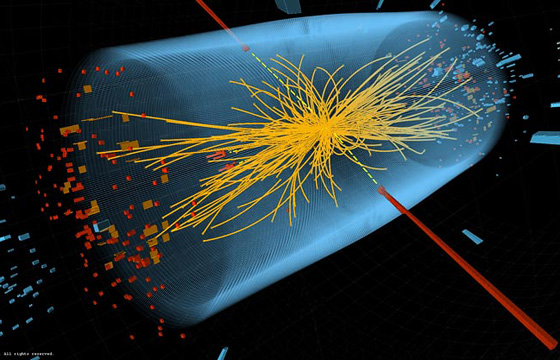
The universe now begins to take on a new character. Welcome to the degenerate era in which the universe is populated by red and white dwarf stars steadily cooling and by the charred remains of supernova explosions: neutron stars and black holes spinning down. Even though these dead stars have used up their nuclear fuels, the universe continues to produce small amounts of energy. They scoop up and annihilate dark matter particles that manage to stray into their grasp. Now here is where change slows to a crawl. It's expected that protons, the building blocks of all atoms, will slowly degrade turning into sub-atomic particles that then decay into photons. All the protons in the universe date back to the early moments of the universe. Their decay marks the end of the degenerate era around a billion, billion, billion, billion years later. That's a one followed by 40 zeros. Our picture of what happens after that depends on what we learn in the coming years beneath the border of France and Switzerland in one of the largest physics experiments ever undertaken. 100 meters underground, the Large Hadron Collider was built to accelerate particles in opposite directions through rings of tubes, 27km around. When they reach nearly the speed of light, scientists will bring them into ferocious collisions. One goal: to define the final time horizons of our universe.
And the final moments of the most persistent objects in our universe. Black holes, ranging from millions to billions of times the mass of our sun, occupy the centers of most large galaxies today. As those galaxies age, much of their mass will spiral towards the center and over trillions of years that mass will fall into ever more ravenous black holes. Conceivably, these ultra-massive black holes could end up weighing as much as a galaxy. When they finally stop growing, will they too be subject to the ravages of time? According to the physicist Stephen Hawking, the answer is yes. He proposed a theoretical process of decay that scientists are hoping to test in high-energy particle collisions at the Large Hadron Collider. The idea is that, throughout our universe, particles of opposite charge constantly well up in the vacuum of space. They normally destroy each other. But when this happens at the event horizon of a black hole, one particle can be pulled in while the other escapes. That has the effect of slowly siphoning energy and mass from the hole. If this is true, then even black holes are eventually doomed. But finding out for sure is not easy. Creating a micro black hole, it seems, will take more energy than any Earth-bound collider yet conceived can pack. That is, unless there's more to our universe and to gravity than we've thought. The key lies in whether the world we know is part of a more complex cosmic reality, beyond the three spatial dimensions plus time that we experience in our everyday lives. If so, we would be like insects living on the two-dimensional surface of a pond, unaware of the deep and complex reality below it. It may be possible that one of these of extra dimensions could intersect our world on an extremely tiny scale. According to some scientists, when particles collide at very high energies the additional gravity needed to create a micro black hole could come from the extra dimension. They'll know a black hole is there when they see the shower of particles predicted by Hawking's theory. Its presence will open a brief window to a deeper cosmic reality while shedding light on the ultimate future of our universe. Based on Hawking's theory, the last black holes will disappear when the clock strikes 10 to the hundredth years from now a number known as a googol. That's the end of our universe. And yet, it's still far short of forever.
What will happen, say, in 10 to the googol, a googolplex, years? If you wrote all those zeroes out in tiny 1 point font, it would stretch beyond the observable universe, or 10 to the googolplex, beyond even that? Will the great arrow of time ever come to rest? Or is it actually curved; destined to cycle back again and again as whole new universes come into being in a way similar to our own? The numbers that describe the time horizons of our universe are incomprehensible, yet they may well be relatively insignificant in the grand scheme of things. Earth and humanity are products of the great era of stars, and we are witness to its great spectacles of gravity and energy. Yet it's fair to say that we occupy a truly tiny period within the vast cosmic sweep of deep time. Rest assured, there will be others somewhere out there who will also look out and attempt to comprehend the changes they see. They too may invent the idea of "time" and develop their own theories on where it's all leading. Will their discoveries - and ours - somehow survive as we all gradually go the way of the stars that made life possible?
comments:
login to comment or register
feature picture
Starburst Galaxy IC 10

celestial events
October 2026
space programs
Curiosity
James Webb Space Telescope
Kepler Telescope
Hubble Space Telescope
International Space Station
Space Shuttle
Apollo 11
learn more at:
wiki
Voyager 1-2
Cold War - Space Race
learn more at:
wiki
feature video